
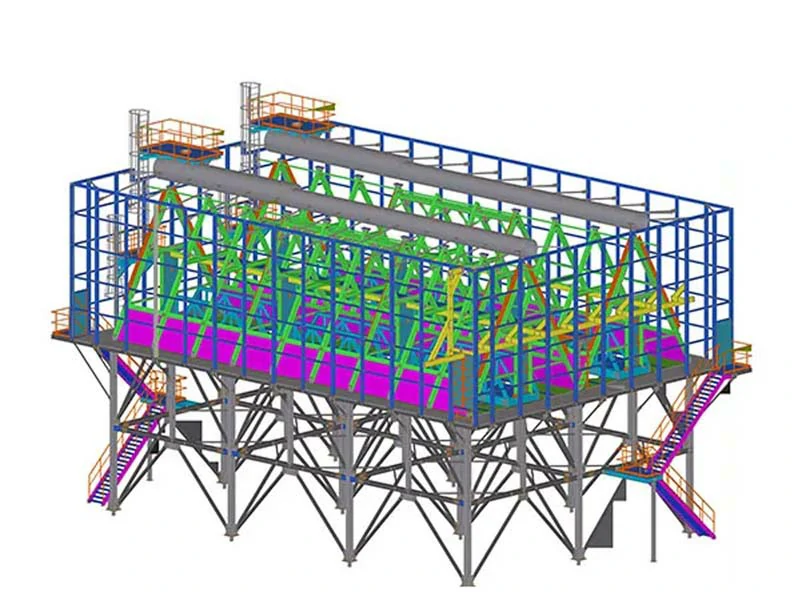
Designing steel structures for heavy petrochemical equipment is one of the most demanding challenges in engineering. You can’t rely on manuals alone—every decision carries consequences, from project delays to costly repairs. I’ve spent years in the field helping engineering and procurement teams avoid traps that can cripple a job site. Let’s talk about what really matters when designing steel supports that serve reliably, year after year.
When we design steel structures for heavy petrochemical equipment, we must address practical, field-proven load scenarios, robust corrosion protection, vibration mitigation, modular assembly, and long-term maintenance planning. Attention to these details determines how well your structure stands up to the real world—and how many headaches you’ll avoid down the line.
The petrochemical industry doesn’t hand out second chances. Small oversights can snowball into shutdowns, safety failures, and massive unplanned costs if you don’t get the details right up front. In this guide, I’ll share genuine lessons and insights from the field, not just what’s in the textbooks.
Load Considerations: Go Beyond the Manuals?
Have you ever looked at a project drawing, ticked all the code boxes, then watched as a structure struggled with unexpected real-world stresses? That’s why codes are just the start. In practice, steel meant for reactors, column supports, and heat exchanger frames must survive more than just static weights.
In my early years, I saw a major refinery upgrade where a beautiful, code-compliant rack buckled—not from equipment weight, but from process upsets during catalyst replacement. Someone hadn’t considered the extra loads when removing heavy internals. Now, I always ask, “What’s the worst these beams will see during maintenance, startup, or emergencies?” We talk to process, maintenance, and operations teams, asking them to walk us through their most difficult interventions, not just ideal scenarios. For emerging technologies or new designs, I add an extra 10-15% safety margin to the calculated loads—think of this as peace-of-mind insurance for the unknown.
Here’s a practical summary I reference:
| Load Type | Standard Calculation | Field Reality |
|---|---|---|
| Dead Loads (equipment self wt) | Based on datasheets | Often rises with design evolution and future upgrades |
| Live Loads (personnel, tools) | Per code minimum | Increases during major overhauls and large-scale shutdowns |
| Dynamic/Process Upset Loads | Theoretical models | Surges unpredictably during process faults or pressure relief |
| Maintenance/Surge Loads | Often overlooked | Usually spike during emergency repairs or catalyst changes |
| Emergency (fire, blast, etc.) | Safety factor based | Must be discussed and modeled, not guessed |
We’ve all learned (sometimes the hard way) that it’s much easier and cheaper to design conservatively at the start, rather than reinforcing columns when the plant is already running.
How can you maximize corrosion resistance in aggressive chemical environments?
Many engineers underestimate how quickly aggressive refinery atmospheres and chemical leaks can turn solid steel into dust. I still keep a photo of an expensive support rack that was eaten through in under five years—not because it was poorly designed, but because the wrong coating was chosen and crevice details were ignored.
What works in a warehouse won’t survive where acids, caustics, and high humidity meet. Today, we never specify just “any paint system.” Instead, we partner with material specialists and applicators, pick corrosion-resistant alloys where needed, and develop multilayer protection strategies. That means hot-dip galvanizing for outdoor racks, duplex stainless for continual splash zones, and carefully selected primers and topcoats for frames exposed to aggressive vapors. We also ask: Where could water collect? Where will chemicals pool if there’s a leak? Every bolted joint, angle, or weld seam is detailed for drainage and easy inspection. Remember, corrosion often starts where you can’t see, so design for maintenance access.
Here’s a quick reference table I use when reviewing options:
| Protective Solution | When to Use | Expected Life (years) | Common Mistake to Avoid |
|---|---|---|---|
| Hot-dip Galvanizing | All weather-exposed steelwork | 20-30 | Not touching up cut edges/welds |
| Duplex Stainless Steel | Frequent chemical exposure | 30+ | Treating it as “fit and forget” |
| Epoxy+Polyurethane | Process/wet areas | 10-20 | Skipping full surface preparation |
| Zinc-rich Primer | At bolted/welded joints | 10-15 | Failing to maintain after initial application |
| Cavity Sealants | Inside closed tubular sections | 15-20 | Not providing weep/drain holes |
One painful lesson: always check the entire structure for any “traps” where water or process fluid can stagnate. We detail every assembly for self-draining, and create an inspection schedule that catches coatings before breakdown occurs.
Why is foundation and vibration isolation crucial for heavy equipment?
Vibration is a silent killer in petrochemical steel. Early in my career, I watched new platforms develop cracks near anchor bolts within months because the steel frame was humming sympathetically with the equipment installed on it. It’s easy to think, “The foundation is someone else’s problem.” But when it affects the life of your structure, it becomes yours, too.
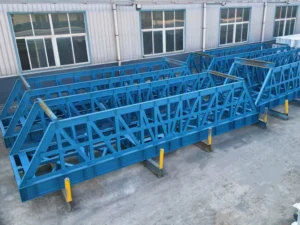
Now, we always start by collaborating with both mechanical and civil engineering teams. We ask not just about equipment weight, but: “How does this compressor vibrate? What frequencies are present during startup and shutdown?” I insist on foundation isolation pads under major drivers and robust gusseting at all support nodes. Retrofitting this later is nearly impossible without weeks of plant downtime and extra cost.
Have a look at our preferred control methods:
| Vibration Control Method | Best Application | Ease of Upfront Design | Retrofitting Difficulty | Remarks |
|---|---|---|---|---|
| Isolation Pads | Pumps, compressors | Easy | Moderate | Chosen for most rotating machinery |
| Deep Pile Foundations | Columns, reactors, heavy eq. | Medium | Hard | Crucial for very large or tall equipment |
| Gusset Plates | All high-movement joints | Easy | Easy | Adds robustness with low material cost |
| Tuned Mass Dampers | Tall towers/flare stacks | Medium | Moderate | Requires detailed dynamic analysis |
After learning from a few costly repairs, I build in vibration checks and damping solutions at the design stage. It’s all about making sure your supports outlast the equipment itself.
Modularization: Is it the game-changer for speed and safer builds?
When a project schedule is squeezed, modular steel is a lifesaver. I recall one energy park expansion where traditional stick-building methods pushed us behind from week one. By switching to prefabricated modules, trial-assembled in the factory, we cut site labor by 30% and avoided hot work in hazardous environments. FAT inspections in the shop meant that when modules arrived, everything fit—no surprises or crane delays.
The modular approach means each section is built, fitted, and quality-checked before shipping. We don’t wait for mistakes to show up on the job site. Plus, site risks drop because there are fewer worker hours outdoors and fewer interfaces with running units.
Compare the two methods:
| Build Method | Field Labor Needs | Schedule Risk | Safety Control | Rework Frequency |
|---|---|---|---|---|
| Modular (offsite/factory) | Low | Low | High | Rare |
| Stick-built (onsite) | High | High | Variable | Frequent |
Today, we specify that all challenging modules be factory-assembled and pass a full FAT. That includes dry fits, bolted alignments, and coating checks. The lessons are clear: investing in modular saves money, improves safety, and lets you sleep at night.
Why is inspection and maintenance access part of great design?
I’ll admit—I used to think walkways and platforms were a “nice to have.” That changed after watching maintenance teams build scaffolding for every routine check in an old plant. What should have been a two-hour inspection became a two-day ordeal.
Now, we standardize platforms at the proper width, ensure every valve or connection has permanent access, and keep ladder angles within safe, comfortable ranges. We always ask the maintenance team what they need before finalizing the design—there’s nothing worse than adding features after commissioning.
If you want a structure that stays safe and cost-effective, focus on these elements:
| Access Feature | Field Benefit | Cost Impact | Common Pitfall |
|---|---|---|---|
| Wide Platforms | Safe equipment, easy NDT | Moderate | Making them too narrow |
| Uniform Ladders | Faster, safer access | Low | Overly steep inclines |
| Removable Panels | Easier bolt/weld inspection | Moderate | Skipping cost for covers |
| Fixed Lighting | Night/weekend readiness | Low | Forgetting in high areas |
Shortcuts here always cost more later. We add these upfront, knowing maintenance teams will thank us for years.
Is digital integration transforming steel structure reliability?
Digital technology is no longer just for process control—it’s now a vital part of reliability in support structures. We embed strain gauges and corrosion rate sensors onto our critical frames. I remember one shutdown we prevented because our cloud-based dashboard alerted the team to a microcrack growing in a key column weld.
Real-time alerts let us schedule repairs before an operator even notices a problem, making “surprise” failures a thing of the past. Now, every steel package we deliver for petrochemical plants comes with optional monitoring. Over time, these insights not only reduce insurance costs, but give our clients confidence that every piece of steel is being watched—onsite or remotely.
The most common digital features we integrate:
| Smart Feature | Function | Value Provided | Example Use Case |
|---|---|---|---|
| Strain Gauges | Measures stress/fatigue | Early failure detection | Welded joints |
| Corrosion Rate Sensors | Monitors protection breakdown | Prevents hidden damage | Splash zones |
| Vibration Sensors | Tracks resonance events | Improved uptime | Rotating machinery |
| Centralized Maintenance App | Records all alarms, actions | Tracks asset history | Plant-wide benchmarking |
If you want a steel structure that keeps earning for decades, consider digital monitoring as essential as any other element.
Conclusion
Designing for tough petrochemical applications is not about overbuilding—it’s about understanding realities, planning for the unexpected, and integrating know-how from everyone on the team. Every careful decision upfront pays off for years in strength, safety, and savings.