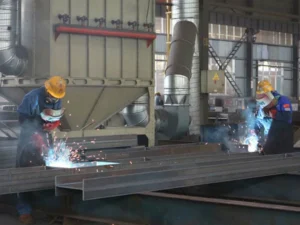
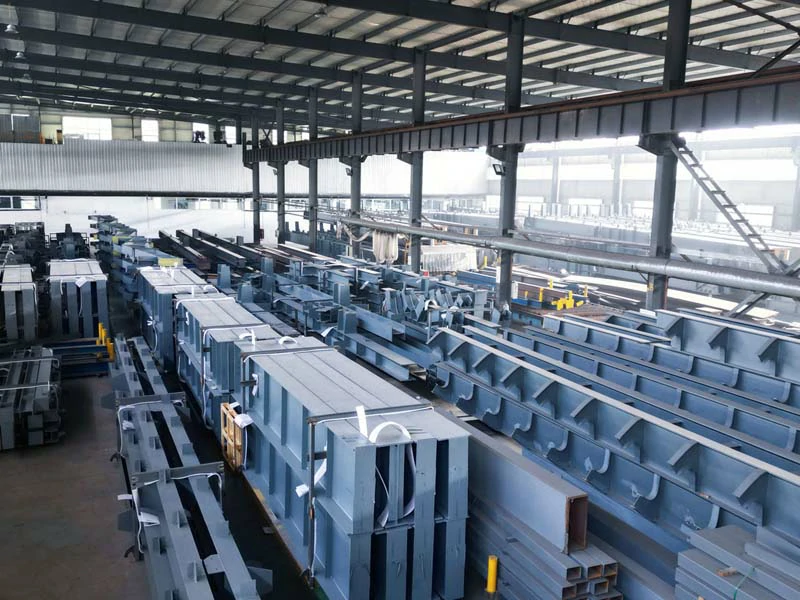
Over the years, working with clients from the petrochemical, energy, and metallurgical sectors, we’ve noticed a clear trend: B2B buyers want not just strong steel structures, but also flawless assembly, consistent quality, and project certainty. If you’ve ever dealt with site rework, fit-up delays, or ambiguous quality claims, you’ll know how painful these “soft costs” can be.
Here, I want to walk you through how automated welding and laser cutting have completely changed our steel fabrication process—delivering the kind of accuracy, traceability, and efficiency that even the toughest clients demand. These aren’t just upgrades; they’re a new business philosophy.
The Real-World Headaches of Traditional Steel Work
We’ve all been there. It seems straightforward—cut, weld, assemble—but in practice:
Human Error Can Ruin a Good Plan
You give two welders the same drawing for a 50-ton beam. One lines up the flanges just so; the other mistracks by 2mm. When you go to assemble on site, you’re suddenly cutting, re-welding, or racking your brain for a workaround. Most rework we see (and the schedule slippage that comes with it) boils down to operator variation.
Delivery Dates Become Guesswork
Manual welding and cutting just can’t match big batch orders or tight schedules. If you get a late order from your client, good luck bumping the queue without throwing the whole workshop into chaos.
Consistency and Proof Are Hard to Come By
Clients, especially on government or energy projects, want proof that every weld meets specs. In hand-made shops, it’s usually “trust us, we’ve done this before.” But when something fails down the line, backup data is almost never there.
Here’s a quick comparison:
| Issue | Manual Method | Automated Method |
|---|---|---|
| Cutting Tolerance | ±2mm | ±0.2mm |
| Welding Consistency | Variable (operator) | High (programmed) |
| Traceability | Paper logs or none | Digital record |
| Labor Cost (per ton) | High | Up to 30% lower |
| Fit-up/Rework Rate | Frequent | Rare |
What Automation Actually Changes
Let’s look at the ways automated welding and laser cutting make a tangible difference, based on what we actually track in our jobs.
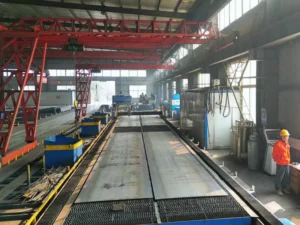
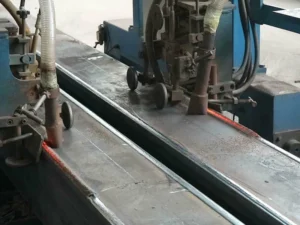
1. We Hit Tighter Tolerances Every Time
Our laser cutting lines routinely hold parts to ±0.2mm accuracy, even on thick steel. That means bolt holes always line up and there’s no ‘field adjustment’—which we all know can cost a fortune in crane time and man-hours.
On the welding side, once we program a robot for a certain seam, the weld bead height, width, and penetration are exact every single time—not just on a good day.
2. We Finish Jobs Faster, with Fewer Surprises
A big bonus with automated gear is speed without sacrificing standards. For example, where an experienced torch operator might handle 6-8 meters of cut per hour, our CNC laser lines finish up to 40 meters—with zero need for grinding or edge clean-up.
Robotic welders also don’t “slow down after lunch” or need breaks. We routinely double output over manual teams—especially when running multi-shift or 24/7 projects.
3. Everything’s Traceable—and That’s Your Warranty
For every major job, we store digital profiles for all cuts and record parameters for every weld (current, voltage, pass/no pass). If a client ever needs a weld log—say, during tendering or later expansion—we can instantly provide lot-by-lot data.
Here’s what a typical tracking record might look like:
| Weld ID | Date | Operator/Robot | Amp Setting | Pass/Fail | Remark |
|---|---|---|---|---|---|
| W3458 | 2024-05-10 | Robot-3 | 210A | Pass | Lap joint, batch #239 |
| W3459 | 2024-05-11 | Robot-3 | 215A | Pass | T-joint, batch #239 |
| C7782 | 2024-05-11 | Laser-1 | – | Pass | Flange cut, 40mm |
Street-Smart Strategies—What We’ve Learned in the Field
Now, there are subtleties you only pick up after years in the business. Here are three key things we do that others often skip:
1. “Compensation” Is an Art, Not Just a Setting
Each steel mill, machine, and shop has its quirks. Over time, we’ve built a table of “real world correction factors”—for example, exactly how much extra to cut for weld shrinkage on S355 plate, or how laser kerf shifts in winter. It’s not in any textbook, but it’s why our assembly gaps are always tight.
| Plate Thickness (mm) | Standard Kerf Comp. (mm) | Shop-tested Offset (mm) |
|---|---|---|
| 10 | 0.15 | 0.12 |
| 25 | 0.20 | 0.18 |
| 40 | 0.25 | 0.21 |
2. We Don’t Guess at Process—We Match Your Specs
For new clients, we’ll often make a pilot run: cut a half-dozen joint variations, weld them up, and invite both your QC and our shop lead to sign off together. That way, you know before mass production that the outcome matches your on-site tolerances.
3. Data Is Power—For Maintenance and Insurance
We use an MES (Manufacturing Execution System) to log every batch—weld settings, operator ID, material lot. If you ever have an issue later on, we can run root-cause analysis in minutes. Some buyers only learn late how vital this “data trail” is, especially when expanding a plant or facing insurance questions after an incident.
What Our B2B Clients Really Care About
If you’re considering a new supplier or project, these are probably on your mind:
- Will the parts fit first time on site?
With automation and pre-tested offset tables, we see <1mm average cumulative error in large assemblies. - What about future extensions or repairs?
With full digital records, we make sure any replacement beam matches the original—critical for chemical plants or refineries expanding modular structures. - Who’s responsible if a weld fails—and can I prove it?
We keep a data archive for seven years. Any complaint or failure (rare as it is) can be traced to operator, machine, and batch, so there’s never any finger-pointing. - Can I actually cut costs or just shift them?
Based on our projects, labor and rework drop, and change orders shrink by 15%+ when robotic manufacturing is applied versus traditional shops.
Fast-Evolving Trends & Why Early Adoption Pays
Here’s what we’re prioritizing right now:
- Integrated Automation:
We’re linking design files directly to fabrication robots—no manual translation. You send us a model, we deliver finished beams, ready to bolt. - Proactive Failure Analysis:
Instead of waiting for something to break, we analyze process data after every job, identifying slow trends before they affect output. Many shops fix mistakes after handover—we prefer to prevent them. - True Cost Comparison:
Automation systems look expensive upfront, but for multi-project clients, our delivered cost per ton is now 10–15% below manual-only shops, factoring in scrap, delivery, and lifetime QA.
In Summary: Why Automation is a Must-Have, Not a Gimmick
We believe automated welding and laser cutting aren’t just “progress”—they’re the new foundation for reliable, scalable, and safe heavy steel structures. For any B2B buyer who hates delays, disputes, or on-site fire-fighting, these upgrades are your best risk-reduction bet.
Our advice? Don’t settle for suppliers who only quote low unit prices. Dig into their technology, traceability, and QA systems. The real value is delivered long after the trucks have rolled out.
FAQ
Q1: Is this overkill for small projects?
Not always. For minor, custom jobs, manual is fine. But for repeated, tight-tolerance, or safety-critical work, automation pays off every single time.
Q2: How can I see automated process data before purchase?
Ask your supplier for a “data book” from recent jobs: CNC logs, weld batches, traceability samples.
Q3: Can automation handle custom shapes or very thick plate?
Absolutely. Modern lasers and welding robots easily process everything from 6mm wall tubes to 50mm girders—faster and more consistently than ever.
Q4: Does this mean I’ll never have to do site rework again?
It dramatically reduces the chance, but good site logistics and installation practices still matter! We partner with clients pre-shipment to plan for these details.
Ready to See the Difference?
If you want steel structures that assemble on the first try, backed up by bulletproof data, talk to us. We’ll run a free process review—let’s see how much smoother your next project can be.